

What does “entry level” mean when you already have a degree and a decade of work behind you?
I came to that question after ten years in insurance and completing a first-class honours law degree. My work involved assessing evidence, negotiating personal injury claims and dealing with litigation and risk. When I look at entry-level legal roles that list previous law firm experience as essential, I find myself asking how much of that experience will count.
It is easy to talk about the difficulty of getting a first job after university. There is another version of the same problem. You have already built a career, you have studied for a qualification in the field you want to enter, and you can still struggle to get an interview because your experience was gained in a different setting.
When relevant experience falls outside the criteria
There are good reasons for some employers to ask for experience in a particular setting. A small team may need someone who can take on specialist work immediately. In law, there will also be procedures and responsibilities that an applicant from another industry has yet to learn.
The question is what that requirement is doing in a role advertised as entry level. If the employer needs someone who can review documents, identify gaps in evidence, communicate clearly with clients or manage competing deadlines, an applicant may already have examples of doing those things. A previous job title tells an employer where someone worked. It can take a closer look at what they did to see whether they have the skills the role requires.
That is where a degree and a substantial employment history can still leave someone stuck. The qualification shows what they have studied. Their work history shows what they have handled in practice. If the initial sift treats experience in a particular setting as a prerequisite, neither may get much consideration.
Are the routes into a new profession becoming harder to navigate?
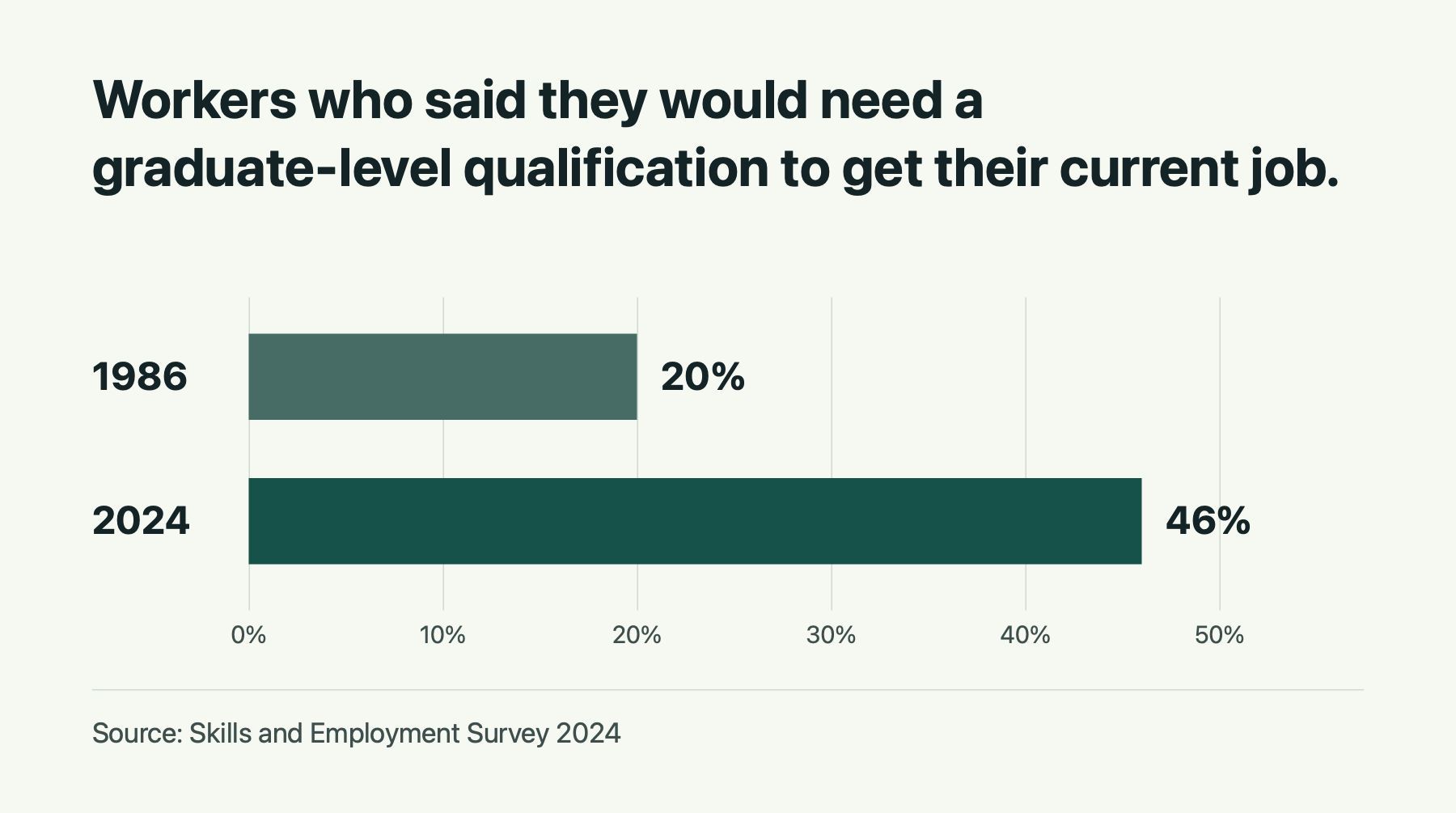
The Skills and Employment Survey found that 46% of workers in 2024 said they would need a graduate-level qualification to secure their current job, compared with 20% in 1986. Those figures cover jobs across the economy and reflect changes in both the kinds of jobs available and the qualifications employers look for. A separate 2026 government and LinkedIn analysis found that hiring was falling in 30 of the 38 entry-level occupations it tracked. The authors suggested that employers with a surplus of applicants were likely to favour candidates who already had the practical skills they needed. That helps explain why a relevant degree can get someone only so far. Skills and Employment Survey · Department for Science, Innovation and Technology and LinkedIn
Taking an internship or placement can help, if you can get one and afford to take it. The Sutton Trust found that around one in five internships in its research offered no financial compensation. For someone changing careers while paying a mortgage, supporting a family or simply keeping up with bills, giving up paid work to gain experience may be out of reach. The Sutton Trust
The personal cost of trying to get a chance
Repeated rejection can make you question whether the time you spent studying or the experience you built will count in the career you want. Research from the Office for Students found that graduates who were unemployed around 15 months after finishing their courses reported poorer wellbeing than those in work. That study leaves open how much of the difference is attributable to recruitment barriers. We also lack evidence linking these specific barriers to crisis helpline use or showing whether any such relationship differs by age. Office for Students

What should an entry-level employer look for?
Before listing sector experience as essential, employers could ask what a person genuinely needs to know on their first day and what they could learn with supervision. A short, job-relevant assessment or an application question that welcomes examples from another industry can give candidates a way to show what they can do.
I recognise that I would have things to learn in my first legal role. I would also bring ten years of experience working through disputes, weighing evidence and communicating with people when the outcome mattered to them. If someone has the right qualifications and can demonstrate the skills you need, does it matter where they learned those skills?