

A degree can equip someone to enter a profession, yet securing a first role may depend on experience that is difficult to obtain without already working in that field. This problem can affect both younger graduates looking for their first job and older graduates retraining or changing careers. UK evidence shows that access to work experience is uneven and that graduates who are unemployed or feel overqualified for their jobs report poorer wellbeing. Crisis-service data also show that financial hardship and suicidal thoughts can occur together. As of November 2026, however, the published evidence reviewed for this essay does not establish whether graduates excluded by entry-level experience requirements are more likely to contact a suicide or crisis helpline, or whether that relationship varies by age. GOV.UK
Entry-level work and access to experience
A 2026 analysis by the Department for Science, Innovation and Technology and LinkedIn found that hiring was declining in 30 of 38 tracked UK entry-level occupations. The authors suggested that, where applicants outnumber vacancies, employers are likely to favour candidates who already possess the practical skills they need. This can make it harder for candidates to enter an occupation even when they hold relevant qualifications. The study used LinkedIn data and covered selected occupations, so it cannot establish how common mandatory experience requirements are across all UK entry-level job adverts. It does, however, document difficult conditions in a range of occupations and identify a reason why suitably qualified newcomers may struggle to compete. GOV.UK
The same competitive pressures apply to opportunities that could help candidates gain experience. The Institute of Student Employers’ 2026 survey recorded an average of 141 applications per graduate vacancy and 102 per internship opportunity among participating employers. These are counts of applications, which can include several applications from the same person. Access also varies by socioeconomic background. In 2025, the Sutton Trust reported a 20-percentage-point gap in internship participation between graduates from working-class and middle-class backgrounds, up from 12 points in 2018. Around one in five internships in its research offered no financial compensation. When prior experience carries weight in recruitment, a graduate’s ability to afford unpaid work can influence the opportunities available to them. ise.org.uk
Graduate employment and mental health
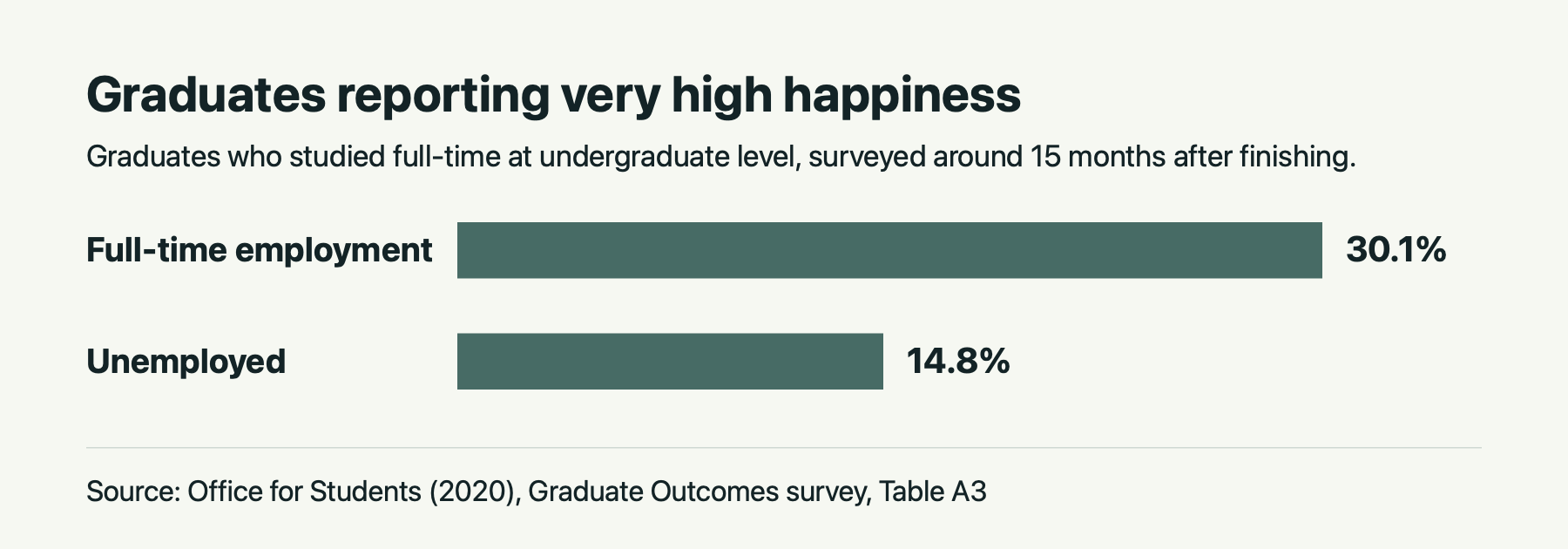
The Office for Students examined graduate wellbeing around 15 months after course completion. In its 2020 analysis, 30.1% of respondents who had studied full-time at undergraduate level and were in full-time employment reported very high happiness, compared with 14.8% of their unemployed counterparts. Across the graduate groups studied, unemployed respondents reported the lowest life satisfaction and happiness and the highest anxiety. Older graduates generally reported better outcomes on some wellbeing measures, including life satisfaction and happiness. The figures are self-reported and capture people at one point in time. Pre-existing mental health difficulties, financial circumstances and other factors could influence both employment and wellbeing. officeforstudents.org.uk
Employment can also coexist with poor wellbeing when graduates feel their qualifications are underused. In a 2022 CIPD report, 52% of graduates who considered themselves overqualified rated their mental health as good or very good, compared with 61% of graduates who considered their qualifications well matched to their role. Perceived overqualification and working outside one’s degree field are distinct. Someone may choose a skilled career in another sector and use their degree extensively, while another person may take work outside their field because they cannot secure a first role in it. The CIPD findings establish an association with perceived overqualification. Measuring involuntary exclusion from a chosen profession would require information about the jobs graduates sought and why their applications were unsuccessful. www.cipd.org
Age, suicidal thoughts and crisis-service use
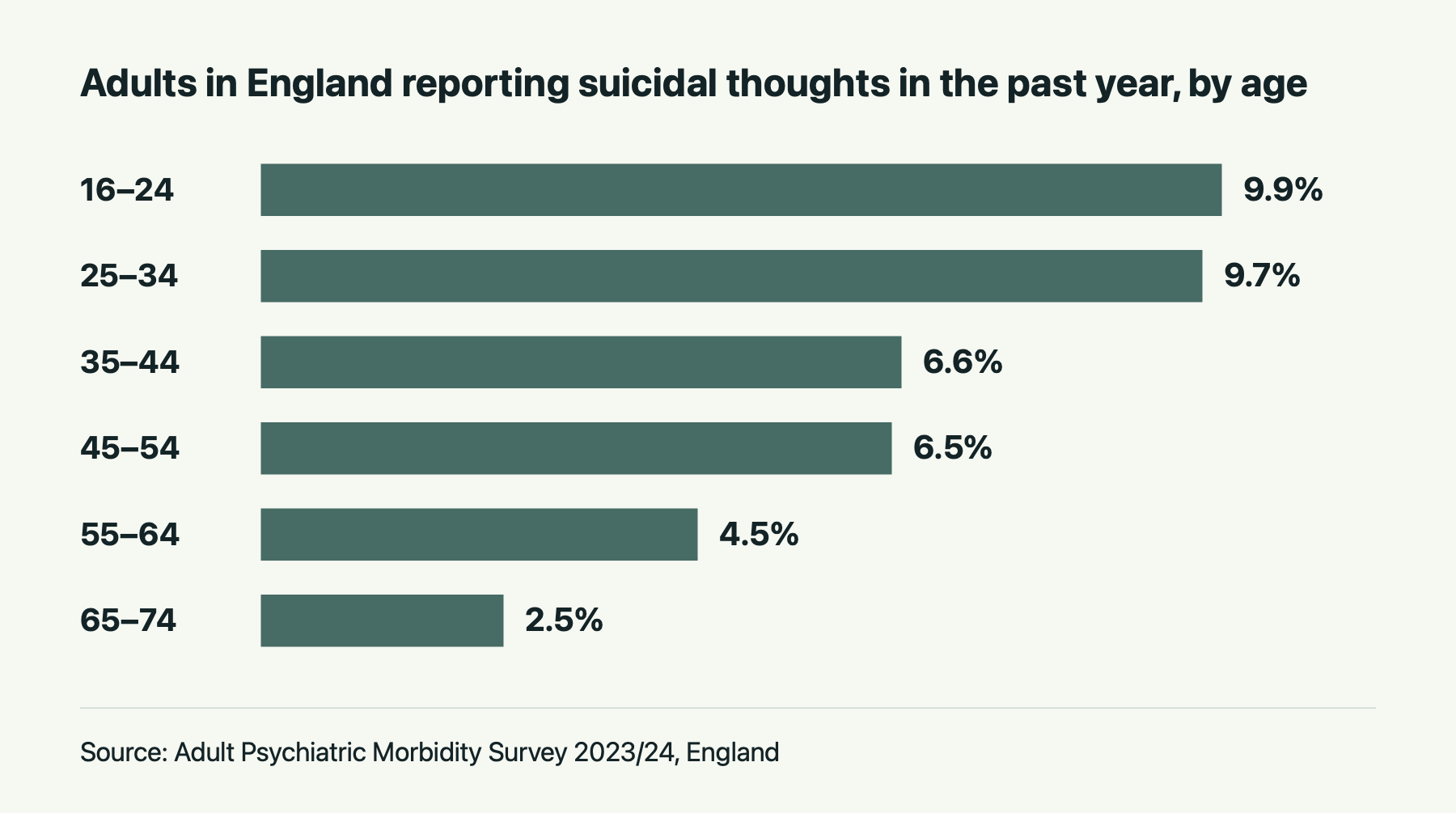
England’s 2023/24 Adult Psychiatric Morbidity Survey provides population estimates across age groups. Suicidal thoughts in the previous year were reported by 9.9% of 16–24-year-olds, 9.7% of 25–34-year-olds, 6.6% of 35–44-year-olds, 6.5% of 45–54-year-olds, 4.5% of 55–64-year-olds and 2.5% of 65–74-year-olds. These figures describe adults in England across employment and education backgrounds. They show why it is important to include adults beyond the youngest age group in research on distress, while leaving open the question of whether recruitment barriers contribute to the differences. assets.publishing.service.gov.uk
Crisis-service data offer a different perspective. In 2024, the UK crisis text service Shout reported that 36% of texters with financial difficulties experienced suicidal thoughts. Among those contacting the service about financial issues, 26% were aged 18–24, 29% were aged 25–34 and 21% were aged 35–44. The age figures describe the people who contacted Shout about money. Published figures do not show what share of each age group experienced suicidal thoughts or had difficulty entering their profession. Samaritans has also recorded broad concerns such as finance or unemployment, and workplace or study issues. Its methodology explains that callers disclose this information voluntarily and that age is sometimes unknown. These records can show which concerns arise during support conversations, while population surveys are better suited to estimating how widespread those concerns are. mentalhealthinnovations.org
Welsh data add evidence about a separate outcome. Public Health Wales reported a crude rate of 150.8 suspected suicide deaths per 100,000 among people recorded as unemployed in 2024/25, statistically higher than the rates for other recorded employment-status groups. Employment status was unknown in 24% of cases, and the report covers suspected deaths. The result identifies an association in Wales, with no information about whether those individuals held degrees, faced recruitment barriers or had contacted a helpline. Public Health Wales
Conclusion
The evidence supports taking the experience barrier seriously. When employers expect applicants to arrive with skills normally gained in the workplace, and the placements that teach those skills are competitive or unaffordable, access to a profession can depend on opportunities some graduates struggle to obtain. Graduate surveys show that unemployment and perceived overqualification are associated with poorer wellbeing. Crisis-service records show that financial concerns and suicidal thoughts can overlap among people seeking support. The size of any direct relationship between entry-level recruitment barriers and crisis help-seeking remains unknown. GOV.UK
A study designed to answer that question could build on HESA’s Graduate Outcomes survey and follow graduates of different ages from the start of their job search. It could record their degree subject, the roles they applied for, employers’ experience requirements, and whether rejection was attributed to those requirements. Tracking wellbeing and voluntary reports of crisis help-seeking over time, alongside prior mental health, financial circumstances and access to placements, would help establish whether the recruitment barrier itself is associated with later distress. Including mature graduates and career changers would allow researchers to test whether the pattern differs by age. www.hesa.ac.uk
References
Chartered Institute of Personnel and Development (2022). What is the scale and impact of graduate overqualification in the UK?
Department for Science, Innovation and Technology and LinkedIn (2026). A snapshot of entry-level hiring in the UK
Department of Health and Social Care (2026). Independent review into prevalence and support for mental health conditions, ADHD and autism, figure 6.5.
Higher Education Statistics Agency (2026). Graduate Outcomes 2023/24: Summary statistics
Holt-White, E. and Cullinane, C. (2025). Unpaid and underpaid internships: Access to internships for graduates. The Sutton Trust.
Institute of Student Employers (2026). How mass applications are changing early careers recruitment
Mental Health Innovations (2024). The cost of living crisis and mental health. Full Shout report with age breakdown.
NHS England (2025). Adult Psychiatric Morbidity Survey: Survey of Mental Health and Wellbeing, England, 2023/4
Office for Students (2020). Graduate wellbeing recorded in the Graduate Outcomes survey, OfS 2020.58.
Public Health Wales. Deaths by suspected suicide 2024 to 2025, figure 7.
Samaritans. Pushed from pillar to post: Methodological appendix, section 5.