
Mediation vs Court Proceedings in the:
Which Is the Better Way to Resolve a Dispute?
3rd June 2026

Lady Brooke Reynolds, LLB
Director

Author: Lady Brooke Reynolds, LLB
Understanding the differences in time, cost, confidentiality and outcomes.
When disputes arise (whether involving family matters, workplace disagreements, business conflicts, or neighbour disputes) many people assume that going to court is the only option. In reality, mediation offers an alternative route that can save time, money, and stress while helping parties reach a mutually acceptable solution.
Understanding the differences between mediation and court proceedings can help individuals and organisations make informed decisions about how best to resolve their disputes.

What Is Mediation?
Mediation is a voluntary process in which an independent, neutral mediator helps two or more parties communicate and negotiate to reach an agreement. The mediator does not take sides, make decisions, or impose outcomes. Instead, they facilitate discussions and help participants explore possible solutions.
Mediation is commonly used in:
Family disputes, including separation and divorce
Workplace conflicts
Commercial and business disagreements
Neighbour disputes
Community and housing issues
The aim is to help parties find a practical resolution that works for everyone involved.

What Are Court Proceedings?
Court proceedings involve presenting a dispute before a judge or tribunal, who will review evidence, hear arguments from both sides, and make a legally binding decision.
Court action may be necessary in certain circumstances, particularly where:
There are urgent safeguarding concerns
One party refuses to engage in discussions
A legal precedent is required
Enforcement powers are needed
However, litigation can be lengthy, expensive, and emotionally demanding.
Comparing Mediation and Court Proceedings
Cost
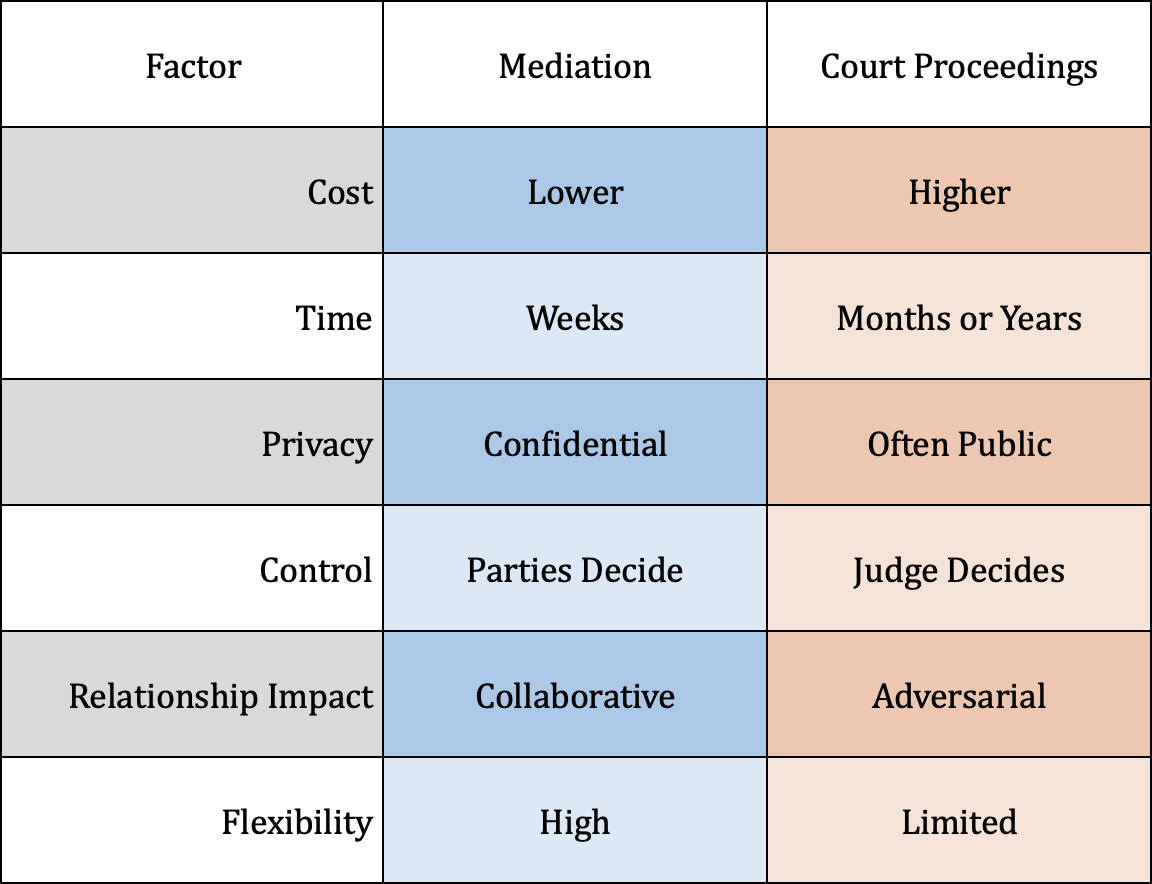
One of the most significant differences between mediation and court proceedings is cost.
Court cases often involve:
Solicitors' fees
Barristers' fees
Court fees
Expert witness costs
Potential costs orders
These expenses can quickly escalate, particularly if a case becomes contested or prolonged.
Mediation is generally much more affordable because it focuses on collaborative problem-solving rather than adversarial litigation. Parties typically share the mediator's fees, making it a cost-effective option for many disputes.
Confidentiality
Court proceedings are generally a matter of public record, although some family cases may have restrictions on publication.
Mediation is confidential. Discussions that take place during mediation are typically private and cannot usually be used in court if mediation does not result in an agreement.
This confidentiality can encourage more open and constructive dialogue.
Time
Court proceedings can take months or even years to conclude, depending on the complexity of the case and court availability.
Mediation can often be arranged within weeks, and many disputes are resolved in one or a small number of sessions. This allows parties to move forward more quickly and avoid prolonged uncertainty.
Control Over Outcomes
In court, the final decision rests with a judge. While the outcome may be legally sound, it may not satisfy either party's preferences.
Mediation gives participants greater control. Because the parties themselves develop the agreement, solutions can be tailored to their specific circumstances and needs.
This flexibility often leads to more practical and sustainable outcomes.
Preserving Relationships
Court proceedings are adversarial by nature. The process often intensifies conflict, making future relationships more difficult.
Mediation encourages communication, understanding, and cooperation. This can be particularly important where parties need to maintain ongoing relationships, such as:
Co-parents raising children after separation
Business partners
Colleagues and employees
Neighbours
By focusing on solutions rather than blame, mediation can help preserve relationships and reduce future conflict.
Family Disputes: Mediation Before Court

In many family cases involving children or finances, individuals in England and Wales are generally expected to consider mediation before making certain court applications.
A Mediation Information and Assessment Meeting (MIAM) is often required before proceeding to court, unless an exemption applies.
The purpose of the MIAM is to explore whether mediation may be suitable for resolving the dispute.
This reflects a broader recognition that negotiated agreements can often deliver better outcomes for families than contested court battles.
When Mediation May Not Be Appropriate
While mediation offers many benefits, it is not suitable for every situation.
Examples where mediation may not be appropriate include:
Domestic abuse concerns
Significant power imbalances
Serious safeguarding issues
Cases involving fraud or criminal conduct
Situations where one party refuses to participate
An experienced mediator will assess whether mediation is appropriate before beginning the process.
Benefits of Choosing Mediation
Many people choose mediation because it offers:
Lower costs
Faster resolution
Greater privacy
Flexible solutions
Improved communication
Reduced stress
Better preservation of relationships
These advantages make mediation an attractive option for a wide range of disputes.
Conclusion
Court proceedings remain an important part of the justice system and are sometimes necessary. However, for many disputes, mediation provides a quicker, more affordable, and less confrontational route to resolution.
By helping parties communicate effectively and work towards mutually acceptable solutions, mediation can reduce conflict, preserve relationships, and avoid the financial and emotional costs often associated with litigation.
If you are facing a dispute and would like to explore your options, mediation may be the first step towards achieving a practical and lasting resolution.